Pre-Work
Assess Your Curriculum Beliefs: What do the teachers and administrators at your school believe about curriculum? At my school, we outlined the following beliefs:- Good curriculum is spiraled and continuously reviewed.
- Good curriculum is research-based and standards-aligned.
- Good curriculum is focused and provides clear instruction.
STEP 1: DEEP DIVE INTO THE STANDARDS.
My first step is to do a close-read of the standards, and to highlight key concepts, terms, and ideas. This will help me process what my students need to learn throughout the year. I also like to make notes in the margins to keep track of any thoughts, and to record connections I make while reading.STEP 2: GROUP THE STANDARDS.
Once I have read through the standards, I think about the logical groupings that will help my students master the concepts. In my example, I chose to have most of my units focus specifically on literature or informational text concepts. This is one approach, though you may choose to group similar concepts together and have units that cover both fiction and nonfiction. There isn’t any right or wrong answer, so have fun with it! Think about the standards that will complement each other and fit your instruction.STEP 3: CREATE YOUR UNITS.
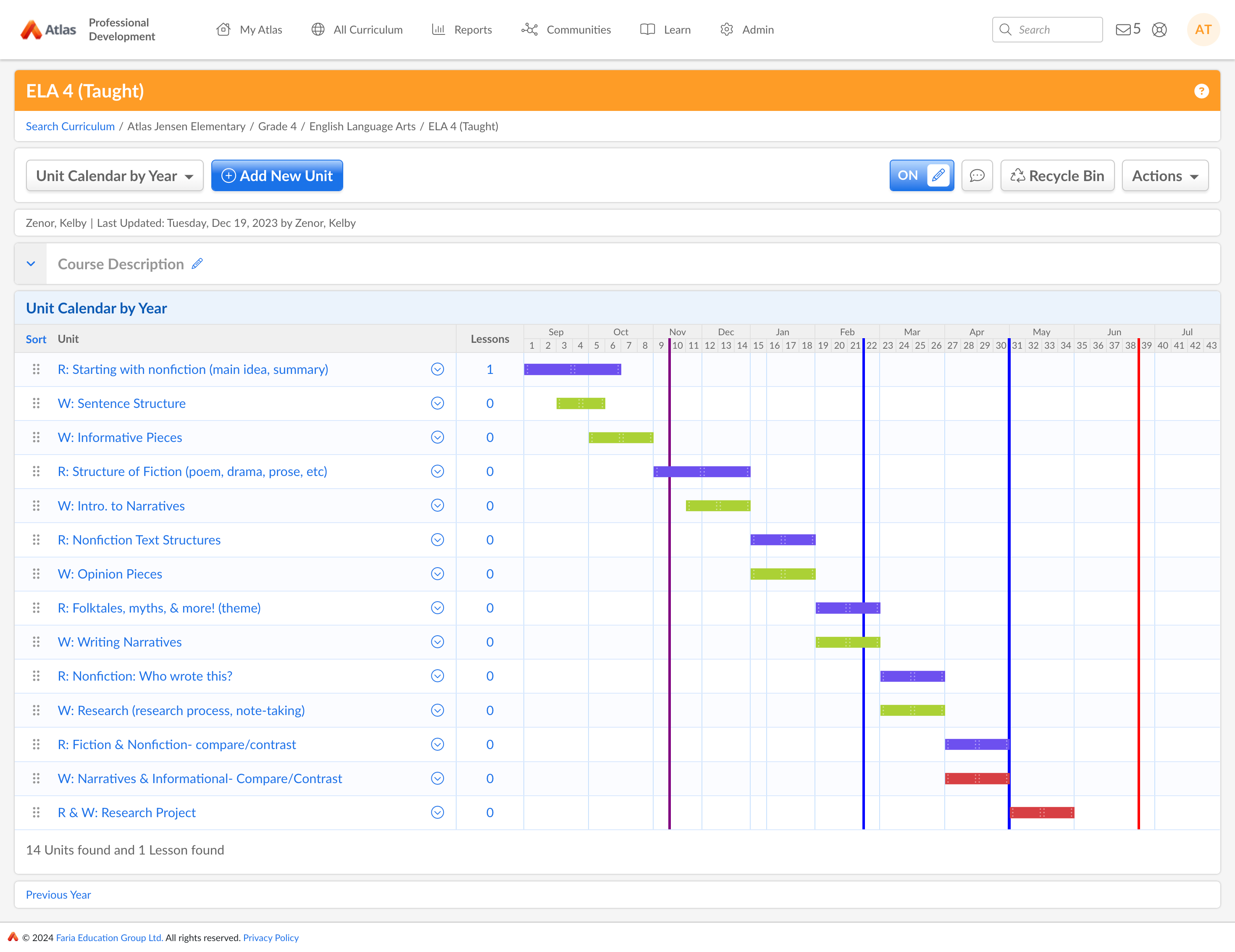
Once the standards are grouped together, go ahead and create the units! You can always enter functional unit titles as a working draft—they are easy to change down the road. I also like to align the standards as soon as the units are created so that my thought-work is preserved.STEP 4: CONSIDER THE TEXTBOOK.
Now that I have my units started, I like to review the textbook and determine which anchor texts I would like to use for each unit. This step provides a chance to double-check that the groupings I picked will complement each other. If the anchor texts aren’t a good fit for the units I’ve started, it is not too late to do a little rearranging!STEP 5: REVIEW & PACE.
At this point, I can take a moment to review my units to ensure that everything still makes sense and is a good match for my teaching style and class goals. I can then take the time to think about how long I expect each unit to take, and when I would pace them throughout the year. In my course, I like to alternate between fiction and nonfiction units, so I can now make sure my calendar reflects that preference. Of course, if you choose to weave them together, you are free to do so.